365 Paragraphs: The Tiny Habit That Rewired How I Write

On January 2nd of last year, I made myself a deal so small it seemed like cheating: one paragraph a day. Not a page. Not a scene. Not "the novel." A paragraph—four or five sentences, written at my desk before the coffee cooled, and then I was free to go about my life.
Three hundred and sixty-five paragraphs later, I'm here to report that it was the most consequential writing year I've had in a decade. Not because of what I produced, but because of what the practice quietly dismantled.
The Myth of the Big Leap
I spent years waiting for the kind of writing days you see in movies: the whole afternoon open, the muse cooperative, the sentences arriving like weather. Those days exist. They also occur roughly as often as a total eclipse in your own zip code.
What I had instead were Tuesdays. Errands. A dentist appointment at 2 p.m. and a vague dread that I hadn't written anything worth the ink. The one-paragraph rule worked precisely because it demanded nothing from a Tuesday. You cannot fail a paragraph. Even a bad paragraph is, technically, a completed assignment.
And here is the surprise nobody warns you about: the paragraph rarely stopped at one. Once the resistance was broken—the way the first step out the front door is the only hard part of a run—the paragraph would often stretch into an hour. But the deal was for one. The deal was always for one.
Most of It Was Forgettable. That Was the Point.
I'll be honest about the math. Of 365 paragraphs, maybe 40 are anything. Of those 40, maybe a dozen became the seeds of real essays—two of which you've read on this site. The rest? Descriptions of my neighbor's snowblower. Half-thoughts about airport carpeting. A truly unhinged paragraph about mayonnaise that I will not be revisiting.
But that's the arithmetic of any craft. A potter throws a hundred pots to get one that stands straight. The difference is that writers tend to believe each attempt must be the attempt, so we avoid the wheel entirely. Daily paragraphs gave me permission to make bad pots.
What Constraint Actually Does
There's a line I return to from the composer Igor Stravinsky, who said the more constraints he placed on himself, the more freedom he found. I finally understand what he meant. A blank page asks an impossible question: what could you possibly say that matters? A single paragraph asks a manageable one: what did you notice today?
Noticing is a much smaller door, and much easier to walk through. Once inside, the room is bigger than it looked.
The constraint also did something to my memory. Because I had to write something each day, I started living like a person who collected things—an overheard line at the Waffle House, the particular quality of light in a Walmart parking lot at dusk, my mother's habit of narrating her own cooking. The paragraph became a net I carried through the day.
If You Want to Try It (Especially This Time of Year)
It's resolution season, which means gyms are crowded and ambitions are enormous and most of both will be abandoned by Valentine's Day. So consider the opposite: a resolution small enough to be insulting.
- Set a floor, not a ceiling. One paragraph. If you write more, fine, but the contract is fulfilled at one.
- Attach it to something you already do. After the first coffee. Before the news. Habits stick to habits.
- Lower the bar until it touches the ground. "I noticed the icicles on the gutters looked like teeth" counts. It absolutely counts.
- Don't reread for a month. Editing too early is how the inner critic gets a seat at the desk.
- Miss a day? Write two sentences the next. The streak matters less than the return.
A Year Later
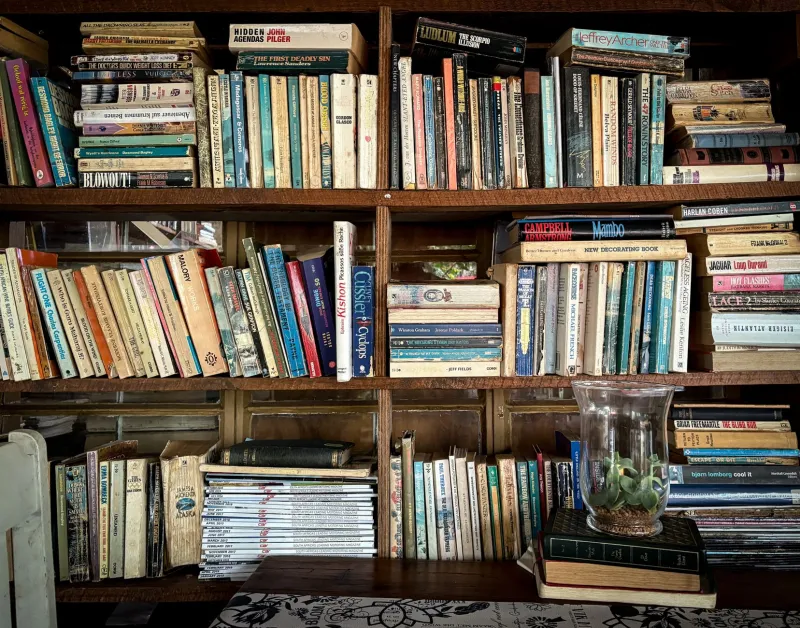
The notebook sits on my shelf now, between a Christie mystery and a Mary Oliver collection—humble company, honestly earned. Flipping through it, I don't see a masterpiece. I see a year of days, accounted for. I notice that a person showed up, in small ways, on ordinary Tuesdays.
That, it turns out, is what a writing life is made of. Not the eclipse days. The Tuesdays.
If you start your own paragraph practice, write to me. I'd love to hear what a year of small doors opens for you.