Confessions of a Disorganized Shelf: Reading My Own Reading History
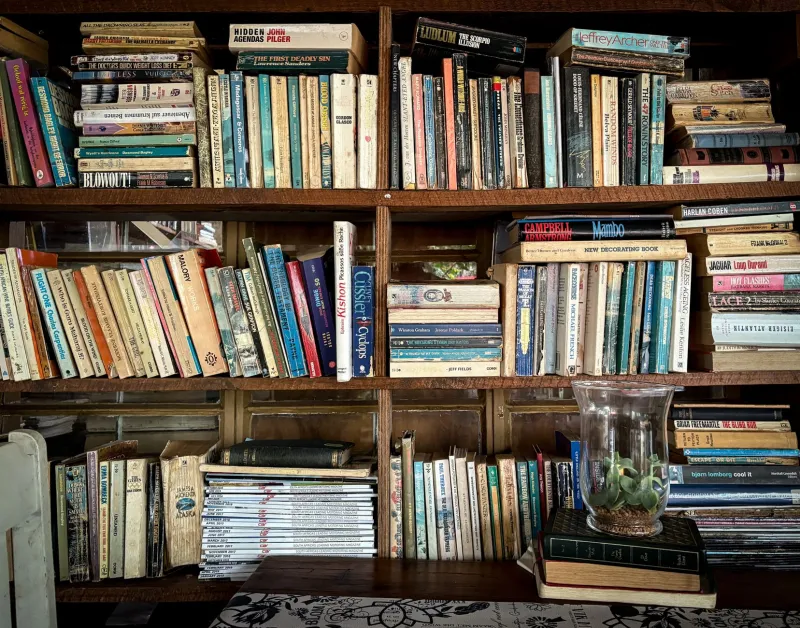
There's a rule among people who photograph their homes for magazines: books should be arranged by color, or by height, or staged with a small ceramic object on top. My shelves follow none of these rules. They follow the archaeology of my attention, and excavating them last weekend was more revealing than any journal I've kept.
The Strata of Impulse
If you read my shelves from bottom to top, you'd find a rough timeline of who I was trying to be. The bottom shelf — hard to reach, dusty — holds the ambition era: thick biographies, a doorstop history of the transcontinental railroad, three separate translations of Dante. I bought these in my late twenties, back when I believed reading was a form of self-improvement you could purchase in bulk.
I finished exactly one of them. The railroad book has a receipt from a now-defunct bookstore in Portland serving as a bookmark, frozen at page 61 like a fly in amber.
Here's what nobody tells you about abandoned books: they don't judge you. They just sit there, patient as furniture, holding your place for a version of yourself that no longer exists.
The One-Night Stand Shelf
Middle shelf, slightly warped from humidity, is where the truth lives. These are the books I devoured — the ones I stayed up past midnight for, the ones I read on the bus with my finger jammed in the spine. A dog-eared paperback of The Stand. A battered copy of Dandelion Wine that belonged to my mother. A crime novel I bought at an airport in Denver and finished before landing in Chicago.
These books are in the worst condition, and that's precisely the point. A pristine book is a promise unkept. A cracked spine is evidence of a relationship.
I've started thinking of this shelf as my actual reading autobiography. Not the books I say shaped me at dinner parties — the Steinbecks, the Faulkners — but the ones I genuinely couldn't put down at 2 a.m. when I had to work in the morning.
The Nomads
And then there are the three books that follow me. Every apartment, every move, every reorganization — they get packed, carried, shelved, and never opened. A collection of Virginia Woolf's diaries. A poetry anthology from a college course. A slim volume of essays a friend pressed into my hands a decade ago with the words "this will change how you think."
Why do I keep them? I genuinely don't know. Maybe they represent a reader I'm still planning to become. Maybe the intention of reading them has become more valuable than the act. There's a strange comfort in keeping the door open — the shelf version of "we should get coffee sometime."
What the Shelf Knows
Writers talk a lot about craft — structure, voice, the discipline of the daily page. But I'm increasingly convinced that what you read, and how honestly you read it, is the deeper education. My organized shelf tells the story I want told. My messy shelf tells the true one.
So here's my assignment for you, fellow readers: pull one book off your shelf at random and ask why it's there. Did you love it? Abandon it? Are you still meaning to get to it? The answer usually says more about you than the book ever could.
And if you find a receipt from 2004 holding your place at page 61 — no judgment. Some of us are just slower at becoming who we meant to be.