Stolen Minutes, Dog-Eared: In Defense of Waiting-Room Reading
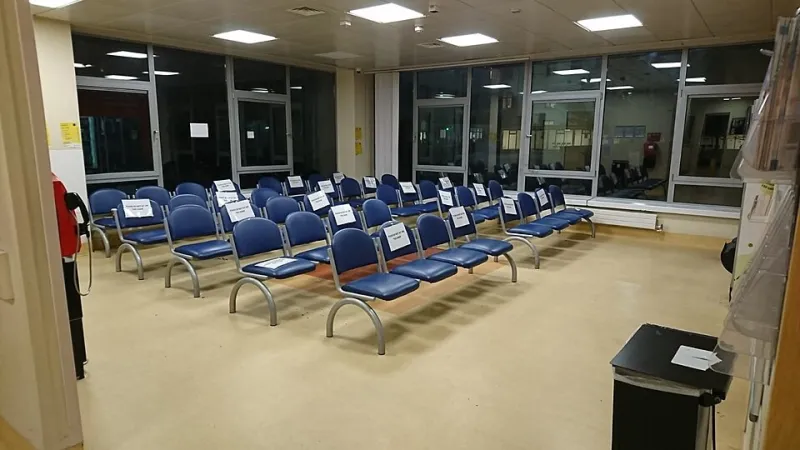
Photo: AugusteBlanqui, CC BY-SA 4.0, via Wikimedia Commons
The book I remember most from the year my father had his knee replaced is not a good book. I want to be clear about that up front. It was a paperback thriller I bought at an airport Hudson News for $11.99, the kind with a single-word title and a man on the cover doing something urgent in a jacket.
I read 190 pages of it in a surgical waiting room in a building with excellent lighting and terrible coffee, glancing up every time the automatic doors opened. I cannot tell you the plot. I can tell you exactly how the chair felt, what the clock above the reception desk did at 2:40 p.m., and the specific quality of the silence when the surgeon came out and said he did fine.
That book is in a box in the garage now. I would not give it to anyone. It's the most important thing I read that year.
The books that live in the glovebox
There is a category of book that never enters the house. It lives in the glovebox, under the passenger seat, in the tote bag by the door that has a granola bar and a spare phone charger in it. It is not the book you're reading. It's the book you're carrying, and those are different jobs.
My current glovebox book is a used paperback of The Friends of Eddie Coyle that I've been in for roughly four months. Progress: sixty pages. Not because it's slow. Because I only open it in the sixteen minutes I'm waiting for a prescription, or the twenty I'm sitting in the lot before a haircut, or the inexplicable forty at the DMV in a strip mall where the chairs are bolted together and the number system has the mood of a small bureaucracy.
I've come to love that book in a way I don't quite love the books on my nightstand, which I've been reading for nine months and have apparently decided to make a career of.
The chair by the fish tank
Here's what waiting-room reading has that planned reading doesn't: it can't be optimized. There's no cozy chair, no candle, no glass of wine, no reading journal. There's a fluorescent hum and a stranger coughing two seats over, and a magazine from 2019, and you.
The conditions are bad. That's the point. When conditions are bad, the book has to do all the work — no, actually, you do. You have to want it enough to read through the hum. That wanting is a muscle, and it's one I worry I'm losing in a year of phones.
Some of the best reading of my life happened in bad chairs. The hospital. The dealership on a Saturday, where I sat for two hours and finished a book I'd stalled on for a month at home. An urgent care on a Sunday in October, when everything I owned felt fragile and the only thing I could do was turn pages.
Why these hours stick
I've wondered about this enough to have a theory, and the theory is boring and probably correct: memory sticks to emotion, and waiting is an emotion. Waiting is a state, not a task. You are suspended. Your brain is doing something unusual — holding two possibilities at once, the good one and the other one — and it records everything around it with unreasonable fidelity.
So you don't remember the book. You remember the reading. And over time the two become the same memory, which is why I can't think about chapter four of a mediocre thriller without also thinking about a hallway and a clock.
There's also this: waiting-room reading is short. Nine minutes. You read a scene, maybe two. You don't get the satisfaction of the arc, so the book stays open in your head afterward, unresolved, humming along like an unfinished sentence. A finished book closes. A book in progress keeps a window cracked.
The uncurated shelf
The books of my planned life — the ones with the nice bookmarks and the good intentions — those have a certain sameness to them. They were chosen by the version of me sitting at a desk on a Sunday, optimistically, in good light.
The waiting-room books were chosen by the version of me grabbing something off the stack on the way out the door. That person is more honest. That person is sometimes frightened, sometimes bored, sometimes just hungry and killing time before a reservation. That person doesn't curate. That person grabs.
I like the shelf that builds from grabbing. It's a shelf of my real life, in order, no selection committee involved.
What waiting teaches a writer
I've written more sentences in waiting rooms than in any coffee shop, and I've read more in waiting rooms than I've read on vacation. Both facts come from the same place: the sweet relief of having nothing else to do.
When you can't leave and you can't start, you get to just be a person with a book for a while. It's the last unscheduled attention I know of. There's no productivity app for it, no way to brag about it, no way to make it look like anything other than what it is — a human being, in a plastic chair, in a loud room, quietly going somewhere else.
I finished that thriller and never looked up the author again. I've thought about those 190 pages more than most of what I read last year. Some reading is the destination. Some is just the company you keep while you wait to find out how something turns out.